Structural Pruning After Repotting: How Long to Wait
Two Major Interventions, One Reserve Budget
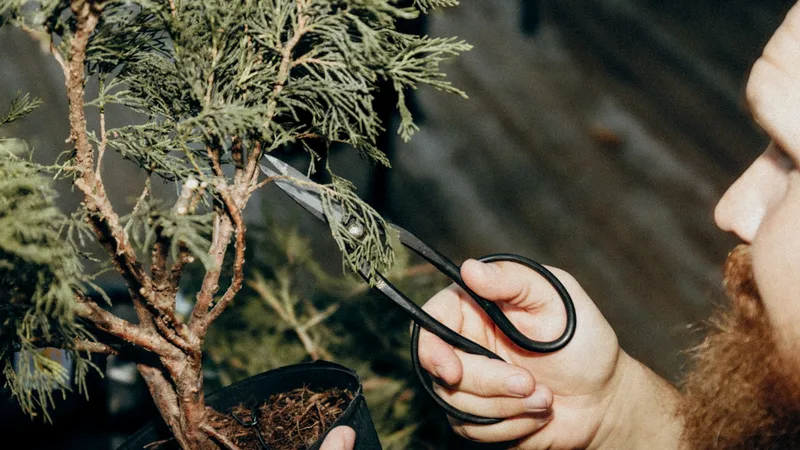
Repotting cuts and reduces roots; structural pruning removes whole branches and reduces foliage. Each one alone is already a significant intervention the tree has to recover from using its stored energy reserves. Done together, or with too little time between them, they compete for the same reserves: the tree ends up without enough roots to restore water and nutrients, and without enough foliage to photosynthesize and rebuild those reserves, at the same time. That combination, more than either intervention alone, is what most often kills or severely weakens a bonsai.
This is especially critical for conifers like hinoki, which barely bud back from old wood at all. If a tree loses vigour after a poorly timed combination of repotting and structural pruning, there's no way to recover lost branches from old tissue, unlike many deciduous species that bud back readily from almost anywhere on the trunk.
How Long to Wait
There's no universally agreed number in the bonsai community; the most common guidance is qualitative — wait until "the roots have reestablished" before reducing foliage significantly. As a practical reference, a minimum interval of roughly six months between a repot and the next structural pruning is a reasonable starting point for most species, comfortably covering the highest-risk period (the first six weeks, when root recovery isn't yet visible above ground) with a safety margin.
That number is a safety reference, not a guarantee. A weaker, older tree, or one that was already struggling before the repot, may need considerably longer. A young, vigorous tree repotted with a conservative root reduction may recover faster. Treat six months as the floor you shouldn't go under, not the target to hit exactly.
How (Not) to Tell If Roots Have Recovered
The honest answer is that, in conifers, there's no reliable visual sign. In deciduous and broadleaf species, new buds swelling and leaves opening are a reasonably clear indicator that the roots are working. In conifers and evergreens, recovery is slower and far less visible — at most you'll see a slight brightening or sheen in the foliage between weeks three and six, which confirms the roots are functioning, but says nothing about whether they're ready to handle heavy structural pruning.
In the absence of a reliable signal, time since the repot remains the best available proxy, imperfect as it is. Use it alongside a general read of the tree: stable growth since the repot, no wilting or drying foliage, and no unusual needle drop for the species.
What to Do While You Wait
The waiting period applies to structural pruning, not to every kind of care. Light maintenance pruning (trimming new growth tips) can generally continue on a shorter interval, typically suggested around three weeks, as long as it's genuinely light and doesn't remove branch structure. Fertilization follows its own waiting rule, typically shorter than structural pruning's, because the risk involved is different (salt-driven root stress rather than foliage loss).
If the app flags a "transplanted X days ago, avoid structural pruning" warning on one of your trees, it isn't a rigid rule stopping you from acting — it's a reminder to assess more carefully before going ahead. Once the minimum interval has passed, always confirm the tree's actual condition before cutting, rather than assuming the calendar moving forward is enough on its own.
Order Matters: Pruning Before Is Different From Pruning After
Everything above applies to one specific sequence: repot first, heavy pruning after, with little time between them. The reverse order doesn't carry the same risk. Pruning hard and repotting on the same day, or in the same session, is a recognized technique deliberately used by experienced practitioners: reducing foliage first lowers transpiration demand right when the roots, reduced next, will have less capacity to supply water. The two reductions end up paired instead of leaving the tree with reduced roots trying to support full foliage.
Some growers prefer yet another order — repot first, then prune only once the tree has recovered a bit, because robust foliage helps drive the repot's own recovery. But notice that even that view agrees on the essential point: nobody argues for heavy structural pruning right after a repot without waiting. The only sequence genuinely discouraged is the one covered above — repotting, then cutting hard soon after — not the reverse.
Bonsai Pilot tracks all of this for you automatically. Start tracking your bonsai care for free →