15 Classical Bonsai Styles
What a bonsai's "style" actually means
In bonsai, style doesn't refer to decoration, it refers to the overall silhouette and trunk movement the tree is trained toward, and almost every one of the classical styles is a direct copy of a real growth pattern found in nature: a pine standing alone on open ground, a tree bent sideways by a coastal wind, roots gripping a boulder on a mountainside. Choosing a style starts with looking at what the material, the trunk you actually have, already wants to do.
The 15 styles below cover the vocabulary most bonsai practitioners refer to, from the single, ramrod-straight trunk of chokkan to multi-tree forest plantings like yose-ue. A tree can combine more than one, sharimiki deadwood technique paired with a windswept silhouette is common, but almost every bonsai in a collection can be described, at least loosely, by one of these fifteen.
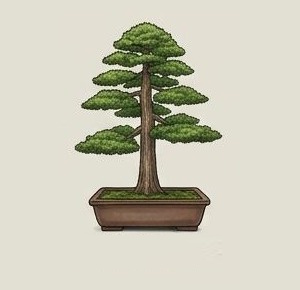
Chokkan — Formal Upright
The most rigorous of the classical styles: a single, dead-straight trunk that tapers evenly from a wide base to the apex, with branches distributed in a roughly triangular silhouette and decreasing in length toward the top. Nebari (surface roots) radiate evenly in all directions, and no branch is allowed to cross in front of the trunk.
It's the style most associated with disciplined, symmetrical growth in open, unobstructed conditions, think a conifer standing alone in full sun. Pines, spruces and other conifers with naturally straight growth habits take to it well; it's demanding to develop from young, flexible material but very stable and low-drama to maintain once established.
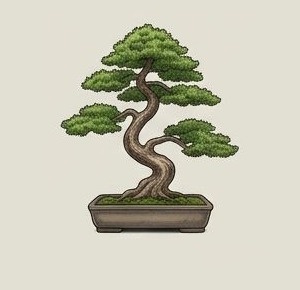
Moyogi — Informal Upright
The trunk still moves broadly upward but flows through a series of gentle S-curves rather than a straight line, and the apex sits directly above the base to keep the tree visually balanced despite the movement. Branches emerge at the outside of each curve, building a natural, slightly asymmetric canopy.
It's the most forgiving and widely practiced style, precisely because it mirrors how most trees actually grow when left to react to light, wind and competition over the years. Almost any species works, junipers, maples, pines, making it the default recommendation for a first styling project.
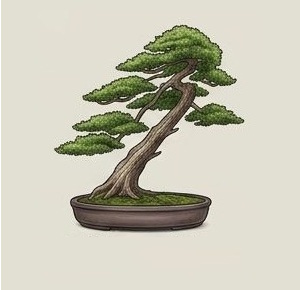
Shakan — Slanting
The whole trunk leans at a fixed angle, typically 60–80° from horizontal, as if the tree grew fighting a constant force, wind from one direction, or reaching for light past a taller neighbour. The nebari counterbalances the lean, with strong roots developed on the side opposite the tilt to sell the illusion of a tree straining against gravity.
Branches on the lower side of the lean are usually kept shorter or removed near the trunk to avoid visual clutter and let the slant read clearly. It suits species with flexible young wood that can be wired into the angle early, and it's a good next step after moyogi for building a feel for asymmetric compositions.
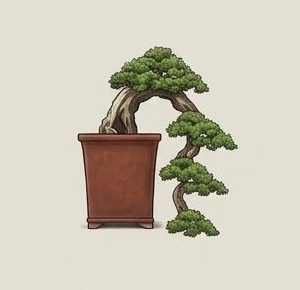
Kengai — Cascade
The trunk drops below the rim of the pot and continues downward, evoking a tree clinging to a cliff face or riverbank after being undercut by erosion or snow load. Because the apex ends up lower than the roots, the style needs a tall, narrow pot to keep the composition from looking top-heavy or the foliage from touching the display surface.
It's one of the more physically demanding styles to train, since the trunk and main branches are heavily wired against their natural upward growth habit early on, and it needs continual vigilance to keep the cascading section healthy (it's shaded and often lower vigor than the rest of the canopy). Junipers and pines, being naturally suited to cliff growth, are classic choices.
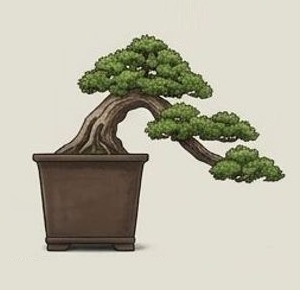
Han-Kengai — Semi-cascade
A gentler version of kengai: the trunk grows outward and downward but the lowest point stays roughly level with, or only slightly below, the rim of the pot rather than plunging beneath it. It reads as a tree growing out over a ledge or riverbank rather than fully hanging off one.
It's a good entry point into cascade-style training, less extreme wiring, more forgiving pot choice, while still building the skill of directing growth away from the trunk's natural upward pull. Works well with the same species used for full cascade, at a lower level of commitment.
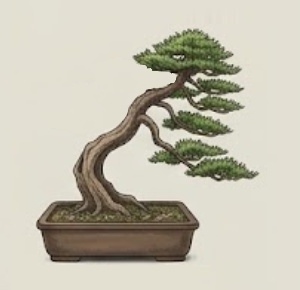
Fukinagashi — Windswept
Every branch and the trunk's overall movement are trained toward one side, as though the tree has spent its life exposed to a prevailing wind, the kind seen on an exposed coastline or mountain ridge. Unlike shakan, the trunk itself doesn't have to lean; what defines the style is that foliage and secondary branching are consistently pushed in one direction regardless of the trunk's own angle.
It's one of the more dramatic, story-driven styles and reads best displayed with that "wind direction" clearly implied, foliage mass concentrated to one side, sparse or absent growth on the windward side. Pines and junipers, with their naturally rugged bark and needle foliage, sell the weathered look particularly well.
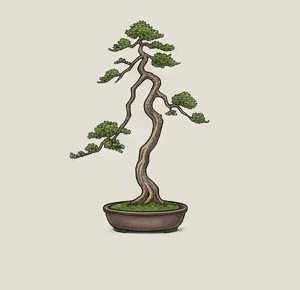
Bunjin / Bunjingi — Literati
A tall, slender, often unconventional trunk with minimal branching, sometimes with just a small tuft of foliage near the apex, that draws almost entirely on the trunk's own line and movement for visual interest rather than an elaborate canopy. It deliberately breaks from the classical taper-and-triangle rules of chokkan and moyogi in favour of something closer to a single, expressive brushstroke.
Named for the Japanese literati painters who prized understated, asymmetric compositions, it's considered one of the harder styles to get right precisely because there's so little foliage to hide a weak trunk line behind. Pines are the traditional choice, but almost any species with an interesting, irregular trunk can work.
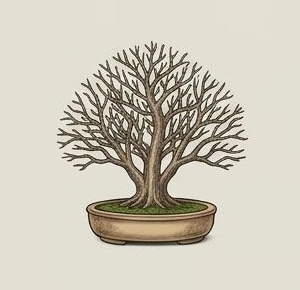
Hokidachi — Broom
The trunk rises straight and then divides into many branches that fan out and upward in a rounded, symmetrical dome, with no single branch or leader dominating the silhouette. Seen from a distance it should resemble an upturned broom, dense, evenly filled foliage with the branch structure barely visible once leafed out.
It's built almost entirely through ramification, repeated pinching and pruning to multiply branch tips, rather than heavy wiring of the trunk. It's the classic style for deciduous, fine-branching species like zelkova and Japanese maple, and it looks its best in winter silhouette, when the fan of bare branches is fully visible.
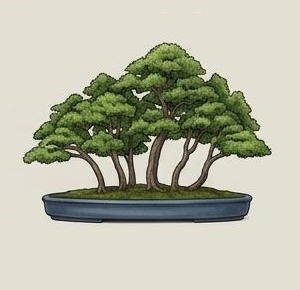
Yose-ue — Forest / Group Planting
Multiple trees, sometimes of the same species and sometimes a deliberate mix, are planted together in a single shallow container to read as a miniature woodland rather than an individual specimen. Trunks vary in height and thickness, with the tallest and thickest usually placed slightly off-centre, and trees are arranged in odd numbers with irregular spacing to avoid a planted-in-a-row look.
Because the composition works as a whole, individual trees can be less refined than they'd need to be as standalone bonsai, weaker material often reads perfectly well as a background tree. Species that naturally grow in stands, birches, elms, and needle conifers, feel the most convincing.
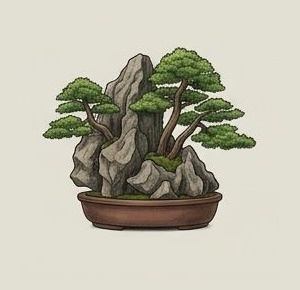
Ishitsuki — Growing on Rock
The trunk and root system grow directly over, and partly into, a rock formation, with roots draped across the stone's surface before finding soil in pockets or at the rock's base. Little or no bare soil is visible around the base of the tree, the rock itself functions as the visual foundation the way a pot normally would.
It demands species tolerant of periodic root exposure and a shallower root run than usual, junipers, and hardy deciduous species like trident maple, are common choices, and the roots need protective wrapping (moss, sphagnum) while they establish their grip on the stone. It's slow to develop but produces some of the most sculptural, landscape-like compositions in bonsai.
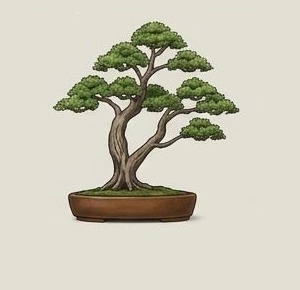
Sokan — Twin Trunk
Two trunks grow from the same root base (or very close to it) and share a single canopy, one clearly dominant in height and thickness, the other secondary and usually slightly behind or to the side. They're rarely planted as equals; the visual interest comes from the contrast in scale between the two.
It occurs naturally when a young tree is damaged near the base and puts out a strong secondary shoot, or through deliberate grafting/selection. Elms, and other species that branch readily from low on the trunk, are classic material.
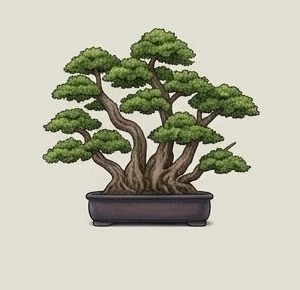
Kabudachi — Clump
Several trunks emerge from a single, shared root base, more of them than in sokan, and generally closer in height and thickness to one another rather than one clearly dominant. The trunks curve outward from the base and lean slightly apart to give each one its own space and light, rather than growing in parallel.
It reads as a young stand of trees that all sprouted from the same root system, which is close to how it actually forms: from a single seedling that's cut back hard early on to force multiple shoots from the base, or a naturally multi-stemmed specimen collected from the wild. Species that sucker or coppice readily, hornbeam, beech, are well suited.
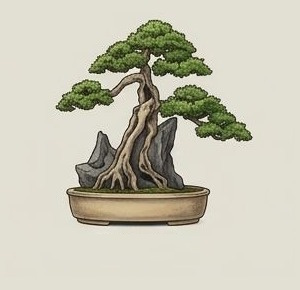
Seki-joju — Root over Rock
The roots grip a tall rock on their way down to the soil, exposed and visible for a section of the trunk's base before disappearing into the pot below, rather than the tree growing directly over the rock's surface as in ishitsuki. Over years the roots thicken and fuse to the stone, eventually looking as though the tree simply grew that way from a seed lodged in a crevice.
It's trained by tying young, flexible roots down along a rock's contours and keeping them consistently moist while they establish, a slow process that can take a decade or more to look convincing. Maples and ficus, both of which root readily and tolerate having roots exposed above the soil line, are frequently used.
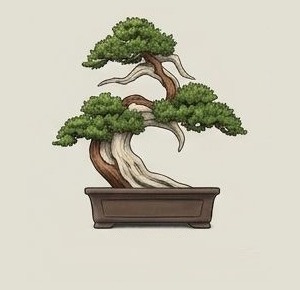
Sharimiki — Driftwood
Not a silhouette style so much as a bark-and-deadwood technique: sections of the trunk or major branches are deliberately stripped of bark and bleached, left as pale, weathered wood standing in contrast against the remaining living bark and foliage. It mimics the scarring old trees accumulate from lightning strikes, storm damage, or centuries of exposure at a harsh, high-altitude site.
The technique is usually split into jin (a deadwood branch or trunk tip) and shari (a stripped strip running along the live trunk), and it's most convincing on species with naturally durable, weather-resistant wood, junipers above all, since the deadwood needs to survive decades outdoors without rotting. It's often combined with another silhouette style (shakan or fukinagashi are common pairings) rather than standing alone.
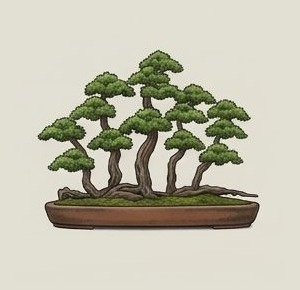
Ikadabuki — Raft
An old trunk is laid on its side, and a row of branches that were originally growing upward from it are trained to continue growing as if each were an independent tree's trunk, while the roots develop along the buried underside of the original trunk. The visual effect is close to yose-ue, a small forest, but it comes from a single tree's root system rather than several separately planted trees.
It mimics a real phenomenon in nature: a tree toppled by wind or flood that survives, with its upward-facing branches turning into new trunks over years while the horizontal original trunk slowly becomes a shared root system. Species that root easily along buried wood, junipers, and many broadleaf trees, are the usual candidates.
Bonsai Pilot tracks all of this for you automatically. Start tracking your bonsai care for free →