How to Repot a Severely Pot-Bound Bonsai
What Does Pot-Bound Actually Mean?
A tree is pot-bound when its roots have filled every bit of space in the pot and started circling the walls instead of spreading outward. In mild cases this is just a sign it's time for a repot. In severe cases the root mass becomes so dense that water can no longer reach the center of the ball — it either can't penetrate at all, or it gets trapped and the innermost roots sit wet for days, which is exactly the condition root rot needs.
The easiest way to check is to lift the tree slightly and look (or gently probe) at the root mass through the drainage holes. If you see a tight mat of roots with little to no visible soil, or the root ball holds its shape like a solid block when you tap the pot, treat it as pot-bound and plan a repot soon rather than waiting for the next scheduled one.
When to Repot a Pot-Bound Tree
The general rule for most bonsai is to repot in early spring, before new growth starts. But that rule exists to minimize stress on a healthy tree — it isn't a hard limit when the tree is already struggling. If a severely pot-bound tree is visibly declining (weak new growth, wilting despite watering, soil that stays soggy for days), the risk of leaving it as-is usually outweighs the risk of an out-of-season repot.
Vigorous, fast-growing species tend to tolerate a wider repotting window — some can be safely worked from early spring through mid-summer. Slower or more sensitive species have much less margin for error outside their normal window, so weigh the tree's overall vigor and species tolerance before deciding to act early.
Loosening the Root Ball Without Tearing It Apart
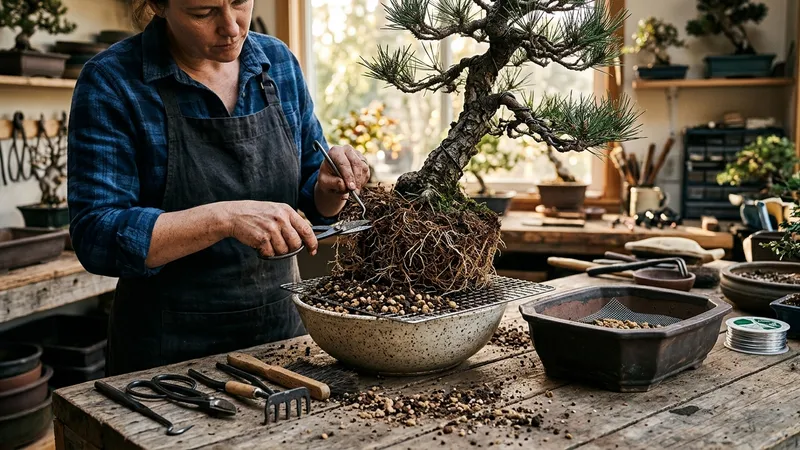
Work from the outside of the root mass inward, and always drag or pick roots outward from the trunk, never in a circular motion — circling tears roots that were growing correctly. A root hook or bent fork works for vigorous, well-aerated bonsai soil; for a refined tree or a delicate nebari, a wooden chopstick used with small stabbing motions is gentler and less likely to snap healthy roots. Keep a spray bottle nearby: you want the root ball to stay lightly moist throughout, since any root that fully dries out during this process is effectively dead.
One technique to avoid entirely for bonsai is "slip potting" — taking the tree out of its pot, undisturbed, and dropping it straight into a larger pot with fresh soil around it. It works for houseplants, but on a pot-bound bonsai it leaves the compacted core untouched. New roots grow into the fresh soil around the outside while the dense center stays starved of water and oxygen, which is often where rot starts later. If a tree truly can't have its roots reduced yet, loosen and aerate the existing root ball first, then pot up — don't just bury a solid block in more soil.
Pruning Circling Roots and Settling the Tree Back In
Once the root ball is loosened, remove roots that circle back toward the trunk, cross other roots, or grow straight up or straight down — these are the ones that thicken into girdling roots over time and choke the tree from the base. Keep the roots that spread laterally and evenly around the trunk; that's what eventually becomes a strong nebari. On a severely pot-bound tree this can mean pruning quite a lot in one session — prioritize the tree's health over the final root design this year, and refine the shape in later repots.
When you replant, work fresh soil into every gap around the roots (a chopstick again does this well) so there are no air pockets, and secure the tree with wire looped over the root ball rather than relying on gravity alone. After that: water in immediately, hold off on fertilizing for about three weeks while new roots establish, and avoid heavy top pruning on the same visit unless the species is a fast, vigorous grower — root work and top work both stress the tree, and doing both at once on a weak specimen is a common way to lose it.
Bonsai Pilot tracks all of this for you automatically. Start tracking your bonsai care for free →