Bonsai Pruning Guide: Techniques for Every Season
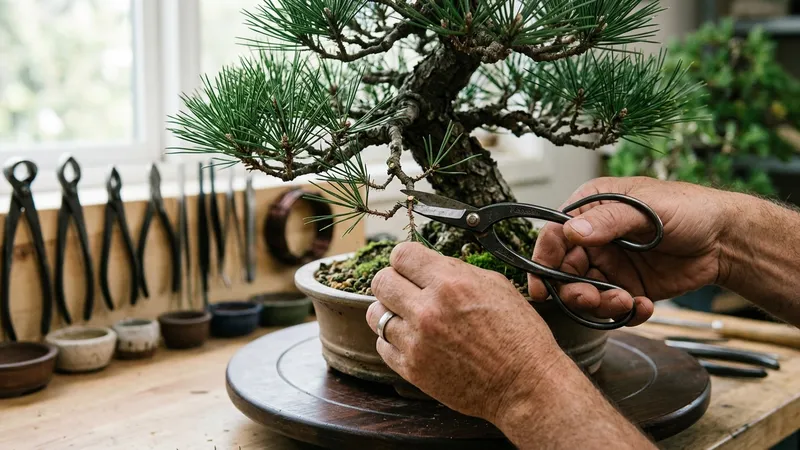
Maintenance Pruning vs Structural Pruning
Bonsai pruning falls into two distinct categories. Maintenance pruning, also called clip-and-grow, involves trimming new shoots back to two or three leaves once they have extended to five or six. This keeps the silhouette compact and encourages back-budding on inner branches. It is performed throughout the growing season on healthy trees and requires only sharp scissors or shears.
Structural pruning is a more aggressive intervention where you remove entire branches to define the trunk line, improve taper, or open the canopy to light and air. Because it creates larger wounds, structural pruning is best done during late winter or early spring for deciduous species, and in autumn for most conifers. Always seal cuts larger than a pencil diameter with cut paste to prevent infection and excessive sap loss.
When to Prune: Seasonal Timing by Species
Deciduous trees such as maples, elms, and zelkovas are best pruned in late winter while still dormant, because the absence of leaves lets you see the branch structure clearly. Light maintenance trimming can continue from spring through late summer. Stop pruning deciduous species at least six weeks before the first expected frost so new growth has time to harden off.
Conifers like junipers, pines, and spruces follow different rules. Junipers can be pinched throughout the growing season by removing the tips of new growth with your fingers. Pines require candle pruning in late spring: shorten or remove the elongating candles before needles open. Tropical and subtropical species such as ficus and Chinese elm can be pruned year-round when kept indoors, but growth is strongest in summer.
Essential Pruning Tools and Techniques
A basic pruning toolkit includes bonsai scissors for fine shoots, concave branch cutters for clean flush cuts, and knob cutters for removing branch stubs. Keep all tools razor-sharp and sterilize them with rubbing alcohol between trees to prevent spreading disease. Dull blades crush tissue instead of cutting cleanly, which slows healing and invites pathogens.
When making a cut, always prune back to a node or a bud that faces the direction you want the next shoot to grow. Cut at a slight angle away from the bud so water runs off the wound. For thick branches, use concave cutters to create a hollow wound that heals flush with the trunk rather than leaving an unsightly bulge. Apply cut paste immediately on any wound wider than five millimetres.
Common Pruning Mistakes and Their Impact on Tree Health
One of the most frequent mistakes is pruning too aggressively at the wrong time. Removing more than a third of a tree's foliage in a single session can shock the tree, stalling growth for months or even killing weaker specimens. If extensive reshaping is needed, spread the work across two or three sessions over successive growing seasons, allowing the tree to recover between each round.
Another common error is neglecting pruning altogether. Unpruned bonsai become leggy and lose their refined shape within a single season. Vigorous species like Chinese elm or ficus can send out long runners that redirect energy away from interior branches, causing them to weaken and die back. Regular pinching and trimming keeps energy balanced across the canopy and promotes the fine ramification that defines a well-developed bonsai.
Bonsai Pilot tracks all of this for you automatically. Start tracking your bonsai care for free →