How to Repot a Bonsai Tree: The Complete Guide
When to Repot Your Bonsai
Most bonsai need repotting every two to five years, depending on species, age, and growth rate. Young, fast-growing trees like Chinese Elm or Ficus may need fresh soil every one to two years, while mature pines and junipers can go three to five years between repottings. The best time to repot is in early spring, just as buds begin to swell but before leaves fully open, because the tree can quickly regenerate new root tips during the growing season ahead.
Tropical and subtropical species such as Ficus, Serissa, and Carmona can be repotted throughout the warm months as long as temperatures remain above 15 degrees Celsius. Deciduous trees like maples and elms should be repotted in late winter to early spring. Conifers, especially pines, prefer mid-spring when candles are just beginning to extend. Avoid repotting during extreme heat, freezing weather, or when a tree is stressed from disease or heavy pruning.
Signs Your Bonsai Needs Repotting
The clearest sign is water sitting on the soil surface instead of draining through. When roots fill the pot and form a dense mat, the substrate becomes compacted and loses its ability to hold both air and moisture. Lift the tree from its pot and inspect the root ball: if you see a thick tangle of circling roots with little visible soil, it is time to repot. Other indicators include slowed growth despite proper fertilization, yellowing foliage without obvious pest issues, and roots pushing out of the drainage holes.
Even if the root ball looks acceptable, the substrate itself degrades over time. Akadama granules break down into fine particles after two to three years, reducing drainage and aeration. Organic components decompose even faster. If you notice the soil staying wet for much longer than it used to, the substrate has likely compacted and needs replacing regardless of root density.
Choosing the Right Soil Mix
A good bonsai soil must drain quickly, retain enough moisture for the roots between waterings, and provide air pockets for oxygen exchange. The classic Japanese mix is akadama, pumice, and lava rock in roughly equal parts. Akadama is a fired clay that holds water and nutrients while still allowing drainage. Pumice is a lightweight volcanic rock that retains moisture and encourages fine root growth. Lava rock adds structure and keeps the mix open and airy.
Adjust the ratio to suit your species and climate. For conifers like junipers and pines, use a drier mix with more pumice and lava and less akadama, around a 30-40-30 ratio. For deciduous trees and tropicals that prefer consistent moisture, increase akadama to about 50 percent. In hot, dry climates, add more akadama or a small percentage of organic material to boost water retention. In humid regions, lean toward more pumice and lava to prevent waterlogging. Avoid regular garden soil entirely: it compacts, drains poorly, and suffocates bonsai roots.
Root Pruning and Aftercare
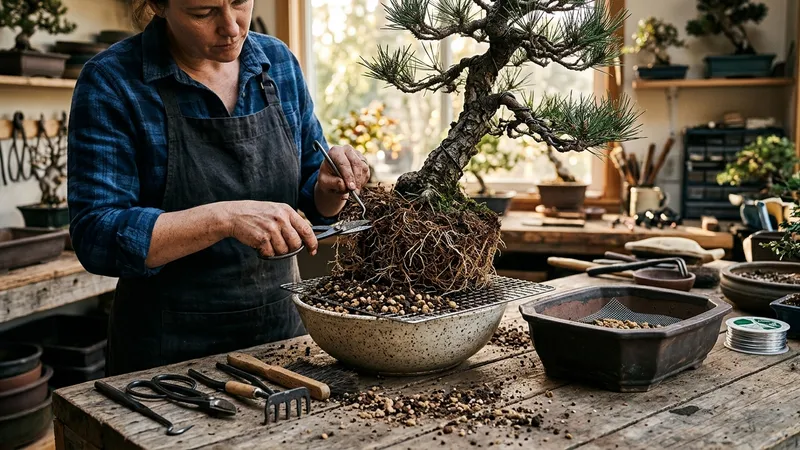
After removing the tree from the old pot, use a root hook or chopstick to gently comb out the root ball, working from the outside in. Remove circling roots, dead roots, and any thick downward-growing tap roots. As a general rule, you can safely prune up to one third of the root mass. Use clean, sharp scissors for small roots and concave cutters for thicker ones. Keep roots moist during the process by misting them if working in dry conditions.
Place fresh drainage mesh over the pot holes, add a base layer of coarse substrate, position the tree, and work soil into every gap between the roots using a chopstick. Secure the tree with wire through the drainage holes if needed. Water thoroughly until water runs clear from the bottom. Place the tree in a sheltered, partially shaded spot for two to three weeks, avoiding direct midday sun and strong wind. Do not fertilize for four to six weeks after repotting, as fresh root tips are sensitive and can burn. Resume regular care once you see new growth pushing strongly.
Bonsai Pilot tracks all of this for you automatically. Start tracking your bonsai care for free →